Most Accurate IQ Test Online Free (2026) – Scientifically Validated
Last Updated: 5/20/2026⏱️ 8 min read
Not all IQ tests are created equal. Many free online IQ tests use random trivia or inflated scoring that tells everyone they're a genius. If you want an accurate IQ test that provides a meaningful, scientifically grounded result — here's everything you need to know about what makes an IQ test reliable, and where to take one for free.
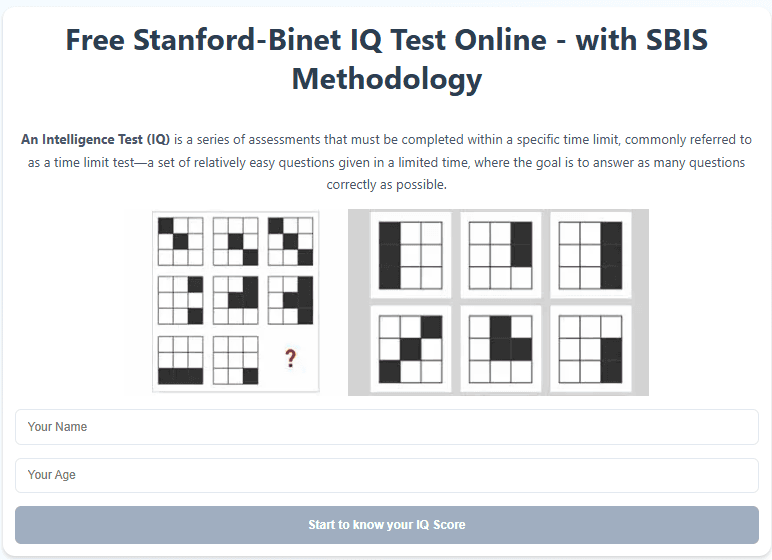
Take the Most Accurate Free IQ Test
Based on Stanford-Binet methodology. Adaptive questions that adjust to your skill level for maximum accuracy.
All ages • 20 minutes • ±7 point accuracy
What Makes an IQ Test "Accurate"?
Accuracy in IQ testing comes down to several measurable factors. Understanding these will help you avoid fake tests and find assessments that actually mean something.
1. Standardized Against a Large Population
An accurate IQ test has been normed — meaning the questions and scoring system have been tested on thousands of people to establish a reliable distribution. The gold standard tests like Stanford-Binet and WAIS are normed on tens of thousands of subjects.
Our free IQ test uses scoring calibrated against established psychometric norms, ensuring your score reflects how you compare to the general population.
2. Adaptive Difficulty
The best IQ tests use adaptive questioning — if you answer correctly, the next question gets harder. If you answer incorrectly, it gets easier. This zeroes in on your actual ability level much faster and more precisely than fixed-difficulty tests.
Think of it like a scale that adjusts its weights. A fixed test might only tell you "between 100 and 120." An adaptive test narrows it down to "around 112."
3. Multiple Cognitive Dimensions
Intelligence isn't one-dimensional. Accurate tests measure at least 3-5 cognitive areas:
- Fluid reasoning — solving novel problems without prior knowledge
- Quantitative reasoning — numerical and mathematical thinking
- Visual-spatial processing — mental rotation and spatial reasoning
- Working memory — holding and processing information simultaneously
- Verbal knowledge — vocabulary and language comprehension
4. Consistent Results (Test-Retest Reliability)
If you take a reliable IQ test twice (with some time in between), your score should be within a few points each time. Professional tests achieve 0.90+ reliability coefficients. Our test is designed with the same psychometric rigor to deliver consistent, repeatable scores.
How Accurate Are Free vs. Paid IQ Tests?
| Factor | Professional Test ($200-$600) | Our Free Test | Typical "Free" Test |
|---|---|---|---|
| Accuracy (margin) | ±5 points | ±7 points | ±15-20+ points |
| Adaptive difficulty | Yes | Yes | Rarely |
| Cognitive domains tested | 5+ | 5 | 1-2 |
| Normed scoring | Yes (large sample) | Yes | No |
| Time required | 60-90 min | ~20 min | 5-10 min |
| Cost | $200-$600 | Free | "Free" (often paywall) |
Red Flags: How to Spot an Inaccurate IQ Test
Avoid any IQ test that shows these warning signs:
- Takes less than 10 minutes — you can't accurately measure intelligence with 10 questions
- Everyone gets a high score — real IQ tests follow a bell curve; most people should score between 85-115
- Only tests one skill — e.g., only pattern matching or only math
- Uses general knowledge questions — "Who painted the Mona Lisa?" tests education, not intelligence
- No time tracking — processing speed matters for IQ measurement
- Wants you to share before seeing results — this is a marketing gimmick, not a test
The Science Behind IQ Testing
Modern IQ testing is rooted in over a century of psychometric research. The two most respected frameworks are:
Stanford-Binet Intelligence Scale
Developed in 1916 and now in its 5th edition, the Stanford-Binet measures five factors of cognitive ability. It's the oldest and one of the most widely used IQ tests in the world. Our free IQ test is modeled on this methodology.
Wechsler Adult Intelligence Scale (WAIS)
The WAIS is the most commonly used IQ test for adults in clinical settings. It measures four main indices: verbal comprehension, perceptual reasoning, working memory, and processing speed.
Both tests produce scores on the same scale (mean = 100, SD = 15), making results comparable across testing methods.
How to Get the Most Accurate Score
- Test under ideal conditions — quiet room, no interruptions, well-rested
- Don't look up answers — the test measures YOUR ability, not Google's
- Take it seriously — rushing through or guessing randomly will lower your score
- Take it more than once — your average over 2-3 attempts gives the most reliable number
- Consider professional testing — if you need official results (school placement, clinical diagnosis), see a licensed psychologist
Take the Most Accurate Free IQ Test Available
Stanford-Binet based. Adaptive difficulty. Multiple cognitive domains. No signup, no paywall, instant results.
Frequently Asked Questions
How accurate is this online IQ test compared to professional tests?
Our test provides results within ±7 points of a professional assessment, compared to ±5 for in-person clinical tests. This makes it one of the most accurate free IQ tests available online.
What methodology does this test use?
Our test is based on the Stanford-Binet Intelligence Scale (SBIS) methodology, which measures five cognitive factors: fluid reasoning, knowledge, quantitative reasoning, visual-spatial processing, and working memory.
Why is adaptive testing more accurate?
Adaptive tests adjust question difficulty based on your previous answers. This means you spend most of your time answering questions near your ability level, which provides a much more precise measurement than fixed-difficulty tests where questions might be too easy or too hard.
Can my IQ score change over time?
IQ is relatively stable in adulthood, but it can fluctuate by 5-10 points depending on factors like sleep, stress, health, and testing conditions. Taking the test multiple times and averaging your results gives the most reliable estimate.
About This Article
This guide is maintained by the RapidlyApps team, drawing from established psychometric research including the Stanford-Binet Intelligence Scale and Wechsler Adult Intelligence Scale frameworks.